Sumatran rhinoceros
Dicerorhinus sumatrensis
The smallest, hairiest and most ancient of the living rhinos, and the closest surviving relative of the woolly rhinoceros. Fewer than fifty remain, in fragmented pockets in Indonesia.
34–47
Population estimate
Critically Endangered
IUCN Red List status
February 2026
Estimate date
Indonesia
Range country
Appearance
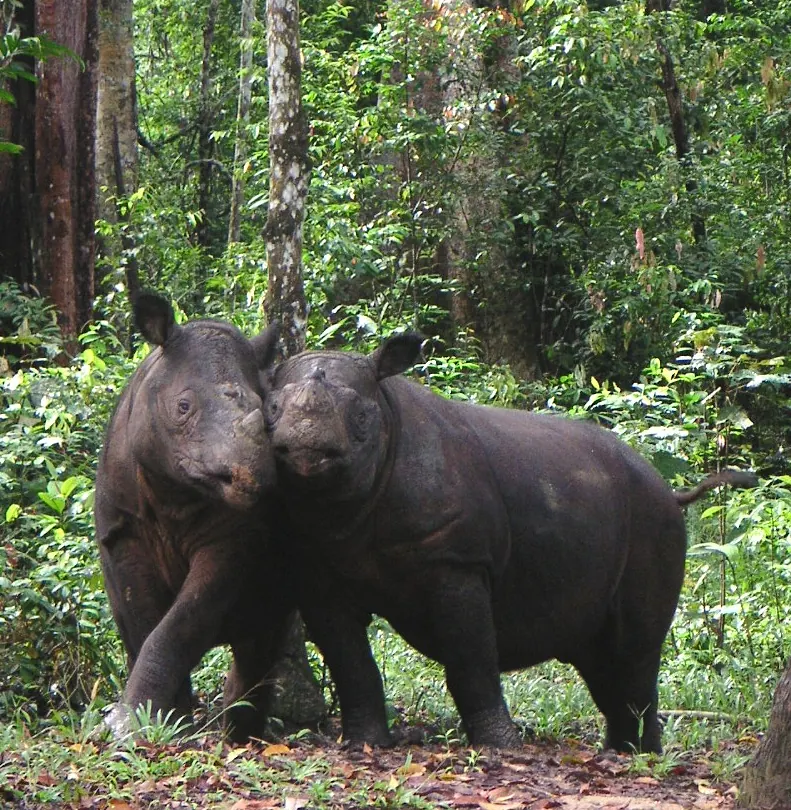
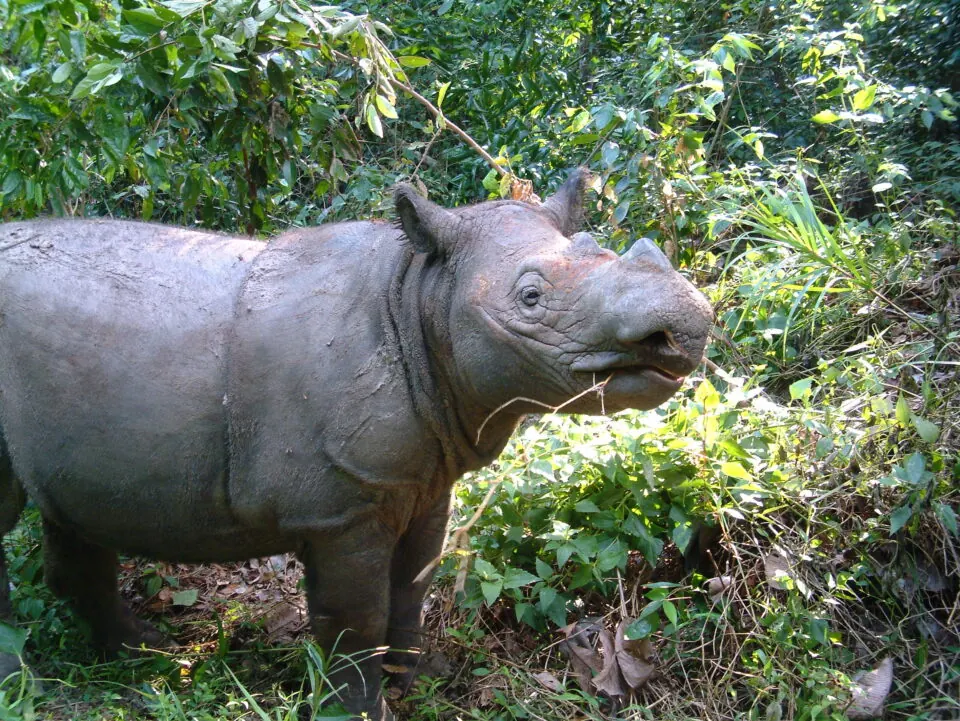
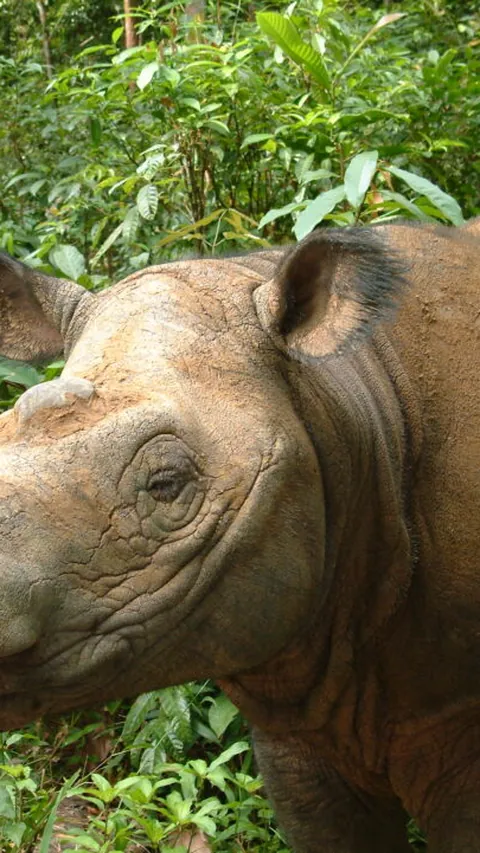
The Sumatran rhinoceros is the smallest living rhino, typically 500–1,000 kg and standing around 1.2–1.5 m at the shoulder. It is the only Asian rhino with two horns: a front horn usually 15–25 cm long, and a rear horn often reduced to little more than a stub.
It is also the only living rhino with a conspicuous coat. Reddish-brown hair covers the body, dense and shaggy in calves and sparser in older animals. Two folds of skin encircle the body, one behind the forelegs and one before the hindlegs. Its hair, size and skull anatomy reflect its position as the closest living relative of the extinct woolly rhinoceros — this is an evolutionarily ancient lineage, not simply a small rhino.
Behaviour and ecology
A browser of dense lowland and montane forest, it feeds on leaves, twigs, saplings and fallen fruit, often breaking down young stems to reach foliage. It wallows daily and depends on mineral licks.
Adults are solitary apart from females with calves, and the species is unusually vocal — a repertoire of whistles, whines and short calls that probably helps widely dispersed animals locate one another in thick forest.
One aspect of its reproductive biology is central to its conservation. Females are induced ovulators, and prolonged periods without breeding are associated with pathology of the reproductive tract — cysts and fibroids that can render a female permanently infertile. The condition is not unique to this species — it is documented in greater one-horned and black rhinos too, and the most severe, life-threatening cases have occurred in the greater one-horned — but in a small, scattered population its consequences are decisive. A female that does not breed may lose the ability to do so. In a small, scattered population where animals struggle to find each other, this turns isolation itself into a cause of reproductive failure.
Threats
Fragmentation and failure to find mates. The surviving animals are distributed across small, isolated pockets that cannot reconnect naturally. Population viability analysis indicates that pockets below about 15 individuals face acute demographic, environmental and genetic risk; on that basis no single wild pocket is currently self-sustaining.
Reproductive pathology. Studies of captured animals have found reproductive tract pathology in a large majority of females examined. Alongside fragmentation, this has shifted the understanding of the species' decline: reproductive failure, not poaching alone, is now treated as a primary driver.
Historical poaching and snaring. Poaching drove the long decline that produced today's fragmentation, and snares set for other species remain a hazard in occupied forest.
Habitat loss and conversion, which reduced a once-extensive range across South-East Asia to a handful of Indonesian forest blocks.
Conservation status and trend
The Sumatran rhinoceros survives only in Indonesia. Its decline has been both steep and geographically total: it once ranged from the foothills of the Himalaya through mainland South-East Asia to Sumatra and Borneo.
Indonesia’s draft Sumatran Rhino Conservation Strategy and Action Plan (2025–2035) gives the clearest current picture. The western Leuser Ecosystem is the only wild pocket confirmed by camera-trap monitoring, at roughly 31 animals, with a smaller eastern Leuser pocket estimated at fewer than eight. Kerinci Seblat National Park was declared free of rhinos in 2004, and five years of intensive survey effort — camera traps, transects, thermal drones and patrols — have produced no confirmation in Bukit Barisan Selatan or Way Kambas. In Indonesian Borneo, only two females are confirmed.
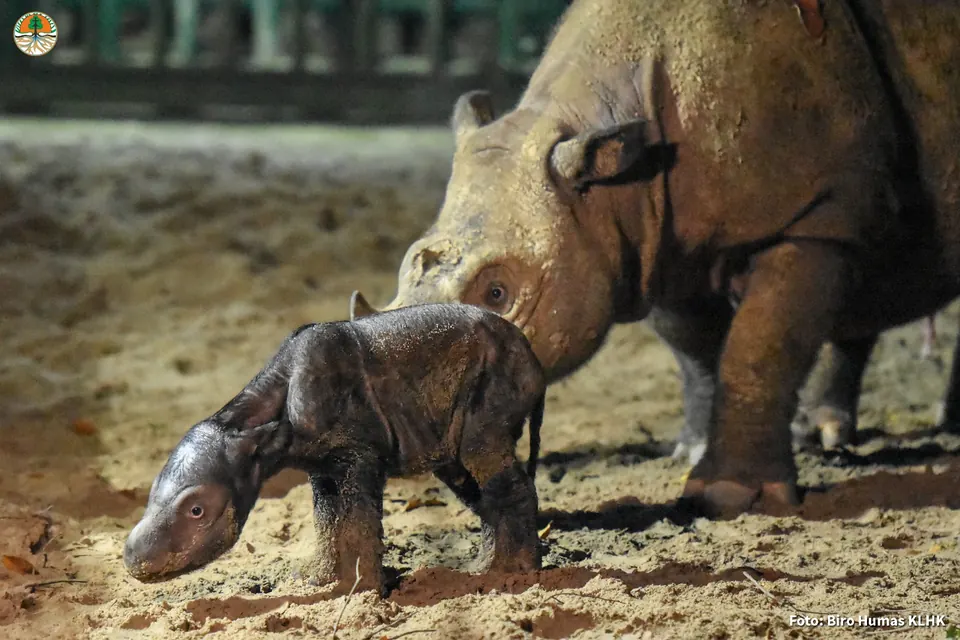
The managed population is the one part of the picture that is improving. The Sumatran Rhino Sanctuary at Way Kambas has produced five calves since 1997 and now holds ten animals. Further sanctuaries are being developed in Aceh and in West Kutai, Kalimantan, to consolidate the animals in those regions.
Current AsRSG priorities
The national strategy is built around managing the surviving animals as a single metapopulation, linking managed breeding to the wild population rather than treating the two separately. The AsRSG supports this approach, and its Sumatran Rhino Conservation Planning and Conservation Breeding & Assisted Reproduction working groups are engaged on:
- Intensive protection of the confirmed Leuser population.
- Consolidation of animals from pockets too small to persist on their own into managed breeding facilities where they can contribute to the population.
- Structured propagation and assisted reproductive technology, including the use of gametes and embryos to move genes between animals that cannot be brought together.
- Cooperation and resource mobilisation between government, partners and international expertise.
The AsRSG works in support of the Government of Indonesia, which holds responsibility for the species and its habitat.
References
Range
Present in Indonesia.
From the field