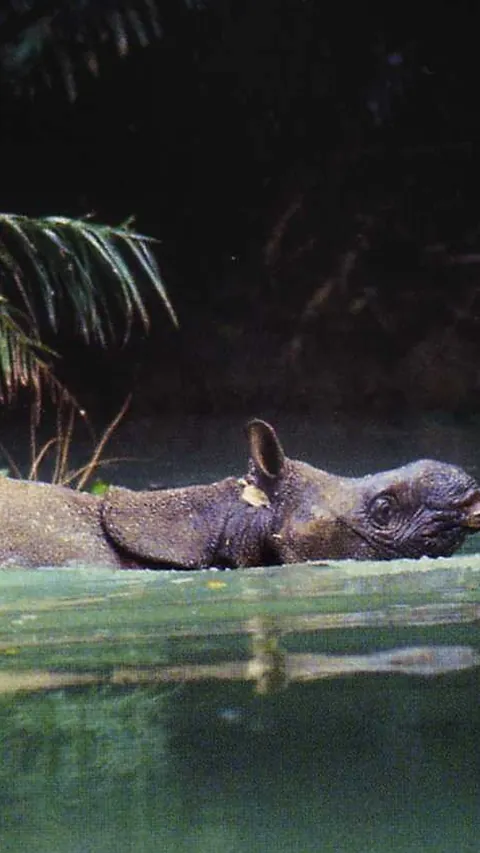
Javan rhinoceros
Rhinoceros sondaicus
The rarest large mammal on Earth. Fewer than fifty Javan rhinos survive, all of them in a single national park at the western tip of Java.
Fewer than 50
Population estimate
Critically Endangered
IUCN Red List status
February 2026
Estimate date
Indonesia
Range country
Appearance
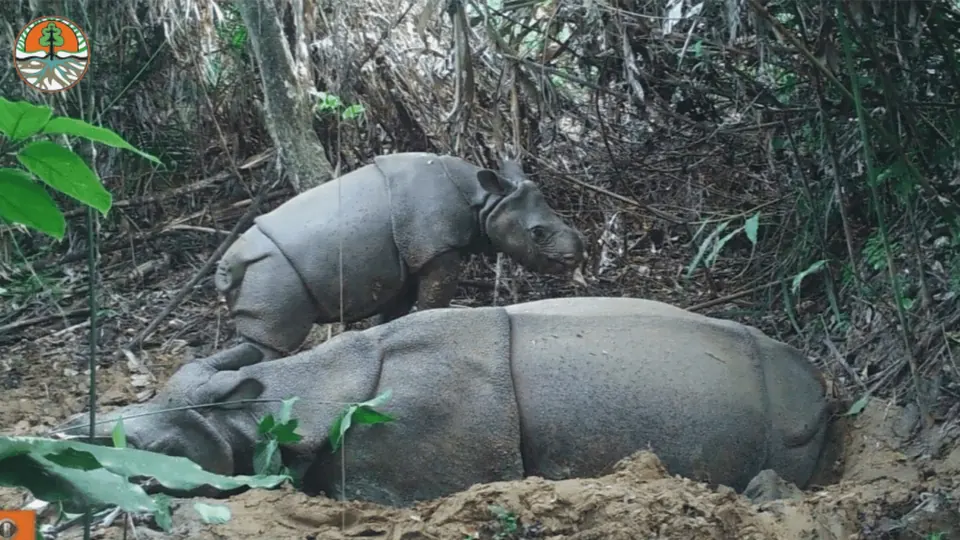
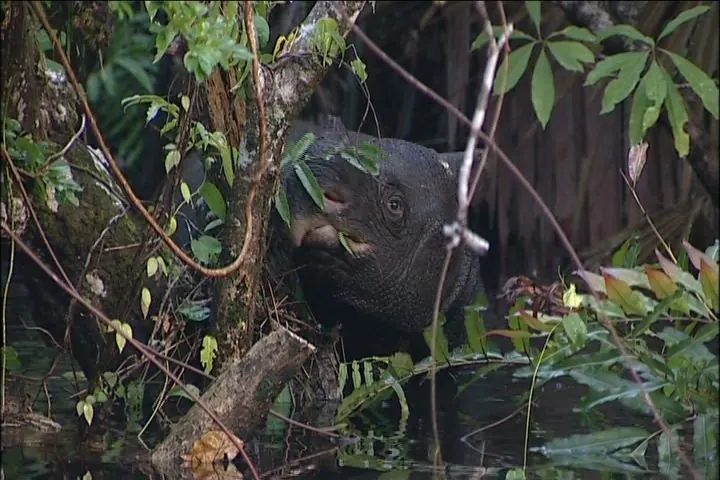
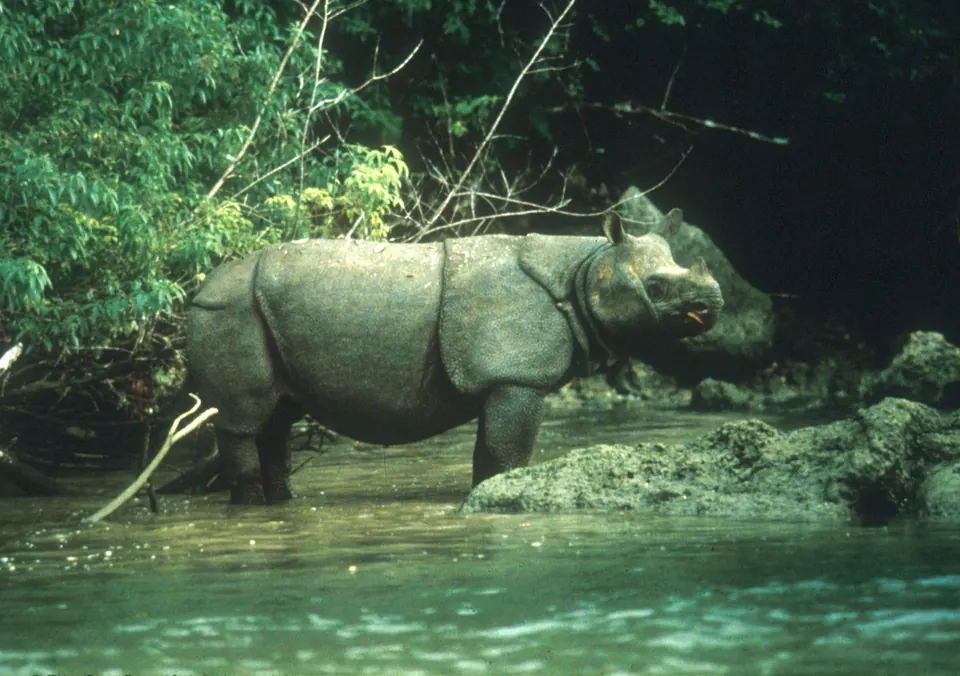
The Javan rhinoceros is superficially similar to its greater one-horned relative but smaller and more lightly built. Its single horn is short — commonly under 25 cm — and in females it is often reduced to a knob or absent altogether, so that many individuals appear hornless.
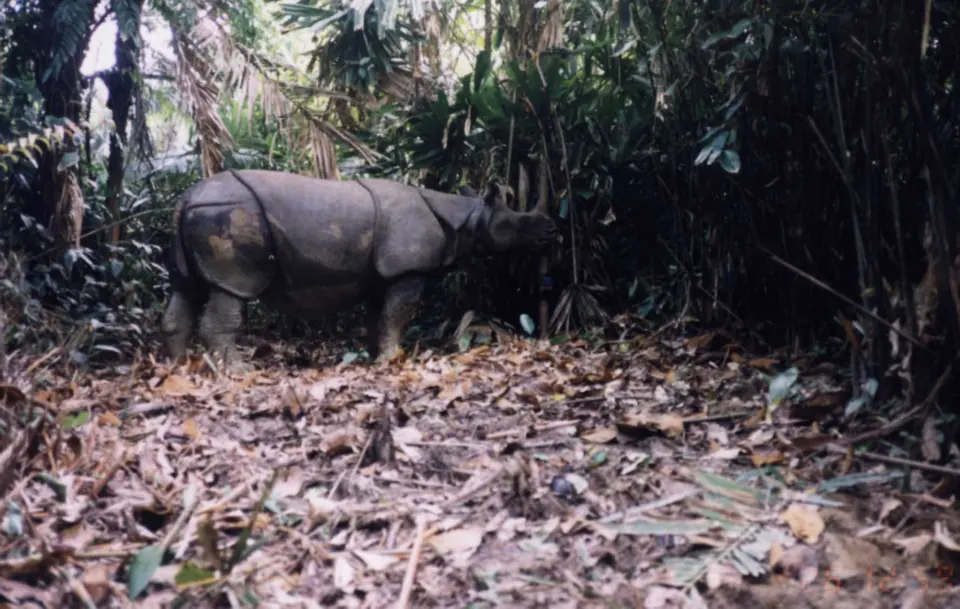
Its hide is the reliable field character. Rather than the heavy folds and rivet-like tubercles of the greater one-horned rhino, the Javan rhino's grey skin is divided by fine creases into a mosaic of polygonal segments. The rearmost neck fold of the Javan rhinoceros almost always crosses the shoulder, in contrast to the greater one-horned rhinoceros, where very few individuals show that trait. The upper lip is pointed and prehensile, adapted for gripping and pulling down vegetation.
Behaviour and ecology
This is a browser of lowland tropical rainforest, taking saplings, shoots, twigs and fallen fruit, and using its prehensile upper lip to bend woody stems within reach. It wallows extensively and visits mineral licks.
Adults are solitary and exceptionally elusive. Almost everything now known about the species' behaviour and demography comes from camera traps, dung and track surveys rather than direct observation — a constraint that shapes every estimate made about it. Gestation is thought to last around 15–16 months, with a single calf and a long interval between births.
Threats
A single population, with no redundancy. The entire species occupies one national park. There is no second wild population and no managed breeding population to fall back on. A tsunami, a volcanic event, a disease outbreak introduced from domestic livestock, or a concentrated poaching episode could remove the species in a single season. This is the defining risk, and it is structural rather than incidental.
Renewed poaching. Twenty-six animals were poached between 2019 and 2023 — roughly a third of the population — demonstrating that the site's protection can be penetrated and that demand for horn continues to reach it.
Habitat competition. Dense stands of palm compete with the browse species the rhinos depend on, progressively lowering the carrying capacity of the habitat.
Demographic and genetic failure. At this population size, skewed age and sex ratios, difficulty finding mates across a large park, and inbreeding depression compound one another. Reproduction can fail even where habitat and protection are adequate.
Conservation status and trend
The Javan rhinoceros once ranged across mainland and island South-East Asia. It is now confined to Ujung Kulon National Park in Indonesia; the last animal in Vietnam was killed in 2010, ending the species on the Asian mainland.
The AsRSG’s current assessment places the surviving population at fewer than 50 animals, down from a high of about 76. Readers may encounter that higher figure elsewhere; the fall reflects a poaching crisis in which 26 animals — roughly a third of the population — were killed between 2019 and 2023.
Both the numbers and the single-site distribution place this species in the final stage before functional extinction. Long-lived animals mask the trajectory — the last individuals may persist for decades — but persistence is not recovery.
Current AsRSG priorities
- A rapid field assessment of the Ujung Kulon population, to establish current status and structure with confidence before further decisions are taken.
- Establishing a second population. While the species occupies one site, no amount of protection at that site removes the risk of losing it entirely. Second-habitat planning is an active priority of the group.
- Managed breeding and assisted reproductive technology, developed under the Conservation Breeding & Assisted Reproduction working group, to raise reproductive output above the level the wild population is achieving unaided.
- Reinforcing anti-poaching capacity in Ujung Kulon National Park.
The AsRSG works in support of the Government of Indonesia, which holds responsibility for the species and its habitat.
References
Range
Present in Indonesia.
From the field